
Certification is a route, not a sticker.
What a product must carry depends on where you sell it, how it is powered and what you claim on the box. We plan that route before the first sample, then issue the paperwork against it. Nothing on this page is a certification held in advance — every document is tied to a specific project and market.
| Standard | Scope | How it is handled |
|---|---|---|
| CE | EU market | Applicable directives identified per product; test route and technical file agreed before sampling, declaration issued against the final configuration. |
| RoHS | EU / UK | Supplier material declarations collected per component; restricted-substance compliance documented per bill of materials. |
| REACH | EU | Substance declarations obtained for housings, finishes, cables and packaging; SVHC position stated per project. |
| UN38.3 | Lithium cells & packs | Test report and transport documentation per battery pack, required for air freight — planned into the schedule rather than after production. |
| IP rating | Sealing | Target rating set in the brief, sealing geometry designed to it, and the claim verified on production-representative samples. |
| FCC / IC | US / Canada | Applied where the product includes wireless or relevant electronics; test route confirmed with the certification route at brief stage. |
| ANSI / NEMA FL1 | Output claims | Light output, runtime and beam distance measured on the in-house integrating sphere so published claims can be defended. |
| UKCA | UK market | Handled in parallel with CE where the UK is a target market, with the labelling differences accounted for in artwork. |
| EU / UK responsible person | Labelling | Address and contact requirements built into the label and packaging artwork from the first draft. |
We deliberately do not list certificates as already held: a document issued for one configuration is not valid for another. Ask for the current test status of the specific platform or programme you are evaluating, and it will be stated in writing.
How claims get verified here.
An integrating sphere is the difference between a marketing number and a measurement.
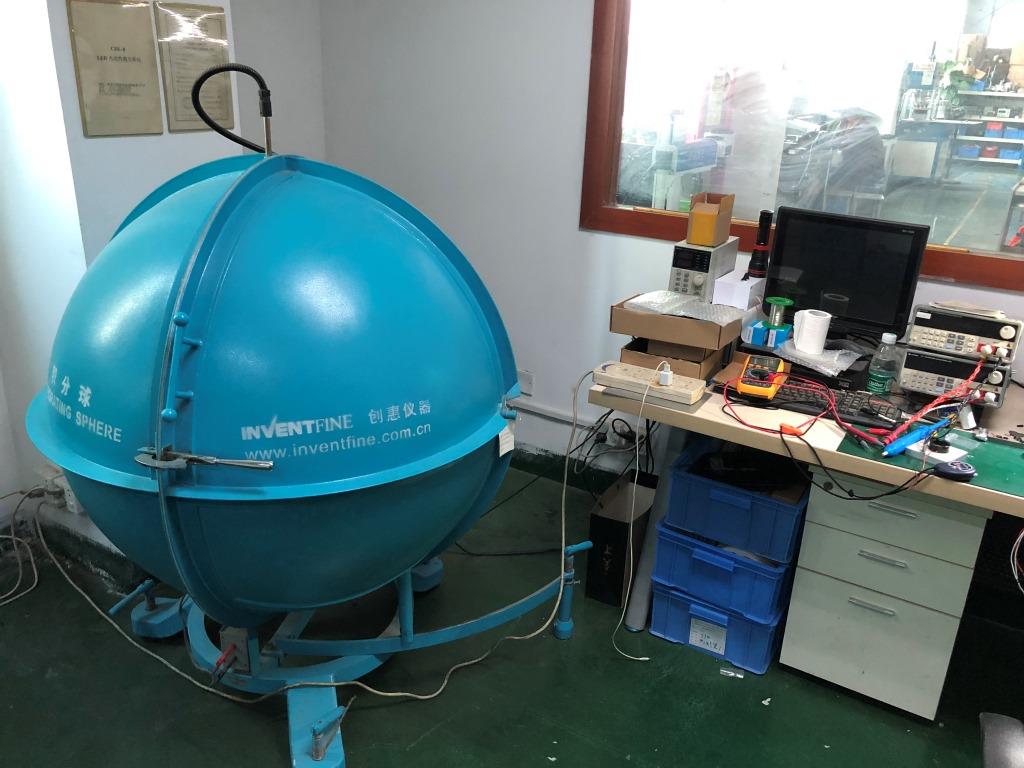
Luminous flux, correlated colour temperature and runtime are measured on site rather than copied from an LED datasheet. That matters most when a listing, a retail box or a distributor contract states a number the product has to live up to.
- Output and runtime measured against the agreed specification
- Electrical behaviour checked on the test bench before packing
- Results recorded per batch, so a claim can be traced to its production run
- Inconsistency between sample and production is a stop condition, not a note
Tell us the market and the model. We will map the compliance route and the label copy.
EU, UK, US, Canada or a mix — the paperwork differs, and the time to know that is before tooling.