
18650 headlamps: one cell, carried in the body
The 18650 is the least interesting decision in a headlamp and the one that decides the most. It sets the mass, the runtime ceiling, the charge route, the transport paperwork and how the lamp behaves at −20 °C. This page is what changes when that cell lives inside the die-cast housing instead of in a pack on the back of your head.
We supply brands, importers and retailers. Every unit here is built under a customer's label from a mould we already hold. We do not sell single lamps to end users.
What putting the cell in the body actually removes
A split pack is four extra parts before it is a product: the pack housing, the cable, the strain-relief entry, and the counterweight that keeps the lamp from tipping forward when the pack hangs behind. Each one is mass. Each one is a sealed penetration that has to survive the same 2 m drop as the body. Remove the pack and all four go with it.
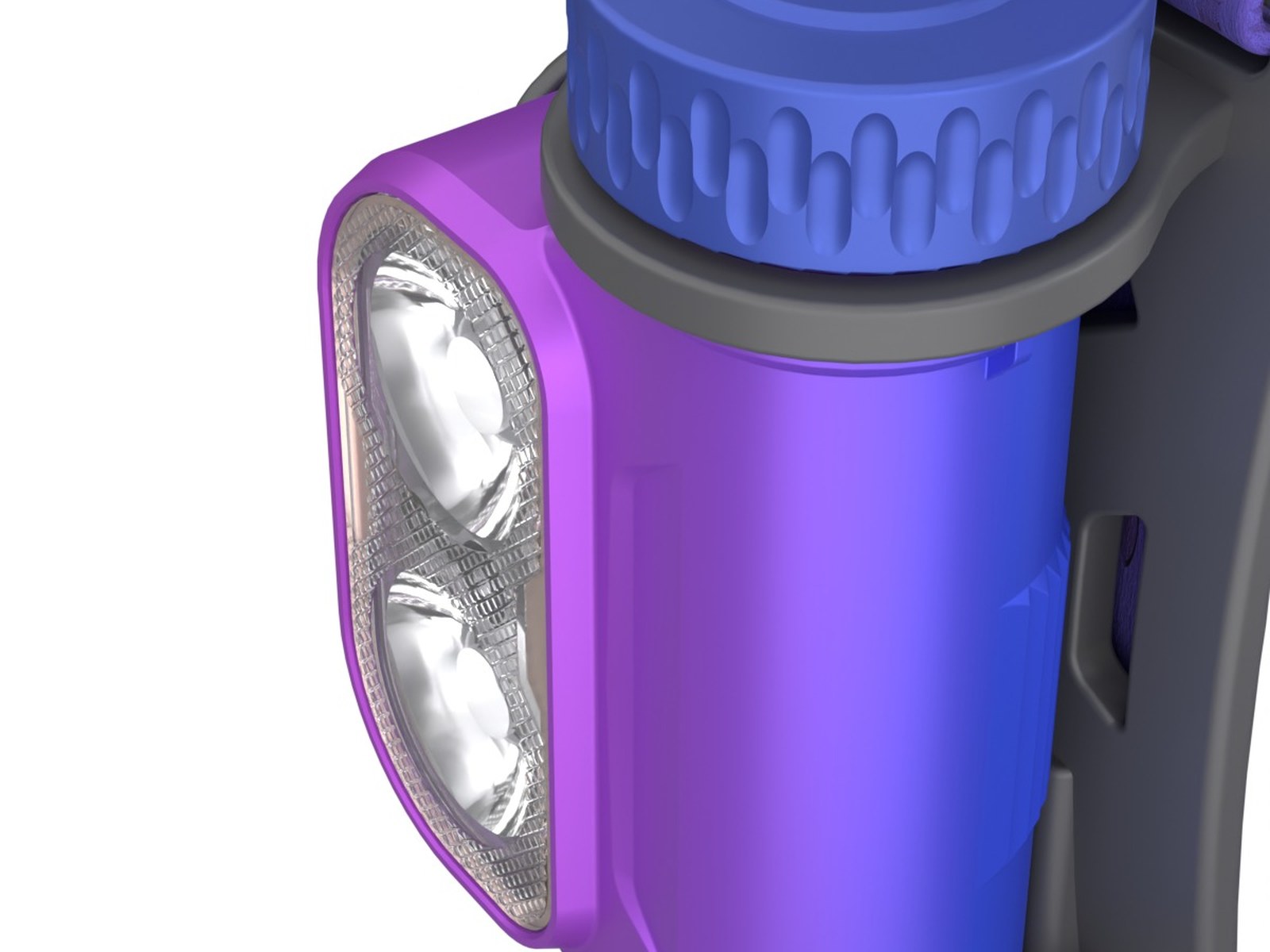
What you get instead is a single die-cast shell doing three jobs — structure, heat path and cell compartment — with one knurled cap as the only access point, and a sealed flap over the USB-C port. The wearer charges the lamp, not a pack, and the lamp can be charged while it is still on the band.
What you give up is thermal separation and capacity. The cell sits close to the driver, so the thermal design has to keep the cell out of the driver's heat rather than trusting distance; and one 18650 is one 18650. For a two-night trip we would point at the split-pack platform instead, and say so.
Three cell architectures, three different products
None of these is better in the abstract. They are three answers to three different briefs, and the brief is what a buyer is actually choosing.
| Architecture | HL-M1 | HL-M2 | HL-M3 |
|---|---|---|---|
| Cell layout | 1× 18650, in the body | 1× 18350, in the lamp | 2× 21700, split pack |
| Charge route | USB-C under a sealed flap | USB-C on the lamp and on the cell itself | On the pack |
| Mass, with cell & band | ≤135 g | 105 g | 413 g with pack |
| Max output | 1,600–1,800 lm | 1,200 lm | 4,000 lm |
| Backup | CR123A primary | Spare 18350 in a pocket | Spare pack |
| The brief it answers | All night at 1,600 lm, nothing behind the head | All-day carry, lowest landed cost | Maximum output, longest throw |
If the brief is “as light as possible”, the compact tier wins at 105 g — see ultralight metal headlamps. If the brief is “4000 lm and 450 m”, the split pack is not a compromise, it is the only way to get there. If the brief is a running line, the cell choice follows the terrain rather than the lab figure — that argument is on the trail running page.
Four things to fix before tooling, not after
On a cell-in-body design these four decisions lock each other. Changing one later means a new housing, not a new BOM.
- Capacity, at a stated discharge rate. “3,000 mAh” without the rate is a number, not a specification. It moves the price and the runtime line most.
- Protection board and cut-off. Over-discharge protection protects the cell and also sets how abruptly the lamp falls out of regulation on low.
- Charge route and current. USB-C under a sealed flap, with the negotiation behaviour fixed. A buyer who specifies “USB-C” and nothing else will get whatever the module does by default.
- Transport paperwork. UN38.3 summary, MSDS and the shipping classification. This is where programmes lose a month, and it is entirely predictable.
Output, mass, ingress, housing and light-source figures are confirmed for the current configuration. Beam distance and runtime are design targets pending the ANSI/NEMA FL1 third-party report, issued with the datasheet at launch. All figures are measured on the in-house integrating sphere at 25 °C ambient.
Questions buyers ask about 18650 headlamps
Why carry the cell in the body instead of a rear pack?
A pack needs a housing, a cable, a strain-relief entry and a counterweight — four parts of mass and two extra sealed penetrations. In-body removes all of it and puts the mass low and forward.
Is one 18650 enough for a full night?
Depends on the mode, and a headline runtime is almost always measured at an output nobody uses. The design gives you two options a sealed pack cannot: a CR123A primary and a spare 18650 in a pocket. The full FL1 table ships with the datasheet.
What does the buyer have to specify on the cell?
Capacity at a stated rate, the protection board and cut-off, the charge route and current, and the UN38.3 paperwork. On a cell-in-body design these lock each other — changing one later means a new housing.
Can the cell be changed in the field?
It sits under a knurled cap, so access needs no tool and does not disturb the optical window or its seal. Whether a spare ships in the box is a programme decision, settled with the packaging.
Does a metal body hurt cold-weather performance?
Metal follows ambient faster than plastic, which is why the housing sits against the band rather than in open air and why the window is published as −20 °C to +55 °C. Below that, a primary CR123A is the honest answer, and the platform takes one.
Do you supply the cells?
Yes — sourced to the agreed specification, tested on receipt, shipped with the UN38.3 summary. We are not a cell manufacturer; what we control is the specification, the incoming test and the build around it.
Send the brief: output, runtime, market, volume. We will send the cell specification and a price.
Both 18650 and split-pack platforms are on moulds we already hold. Ask for both and compare the mass and the landed cost.