
A trail running headlamp is three decisions, not one
Output, beam pattern and mass. Get the order wrong and a 900 lm lamp is worse to run with than a 400 lm one. This page is the specification brief we would hand a brand building a trail line — the same brief we build to, with the numbers attached.
You are on a manufacturer's page. We do not sell single lamps to runners. If you are choosing one for yourself, the guidance below is what to check on any product page. If you are building the line, it is what to specify.
How many lumens a trail running headlamp actually needs
Lumens are the number buyers compare and the number that decides the least. What decides whether a lamp is usable is how much of that output lands where you are about to put your foot. Still, you have to pick a tier, so here is where the tier lines fall in practice.
| Ground you are running | Useful output | What that buys you |
|---|---|---|
| Pavement, fire road, easy trail | 150–300 lm | Ambient light does part of the work. More output here mostly flattens the near field and costs battery. |
| Non-technical trail at pace | 300–500 lm | Enough to read the surface 5–8 m ahead — the distance you cover in the two seconds before you commit a foot. |
| Technical descent, rock and roots | 500–800 lm | Reading 15–20 m ahead at speed. This is the tier that justifies a burst mode rather than a higher sustained one. |
| Night navigation, marked ultra | 300–400 lm sustained | The sustained figure is the one that decides your battery, and the one a spec sheet usually hides behind a peak number. |
These ranges are what we see buyers specify for this use, not a published standard — there is no EN number for “enough light to run technical ground”. Treat them as a starting brief to argue with, and set your own tier from the retail price you need to hit.
The number to put on the box is the sustained one. A peak figure that lasts ninety seconds is a marketing number. If your line is sold on an ultra or night-race claim, publish the mode table with the FL1 report and let the sustained figure do the selling — it is the only number a reviewer will not be able to call out.
Why beam pattern beats output
A single tight spot at 500 lm lays a bright circle on the trail and leaves everything outside it black. On a straight fire road that is fine. On a switchback it is dangerous, because the turn is outside the circle and you find it by falling into it.
The pattern that works is a spot for distance plus a wide flood for the ground at your feet, with the two controllable separately — wide on the climbs, spot forward on the descent, both on when you are uncertain. That is a two-source optic in one housing, and it is the single most useful thing a trail lamp can have after a band that does not move.
There is a second reason to split the sources: a flood at 200 lm does more for foot placement than a spot at 500 lm, and it draws less current. Buyers who ask us for “the brightest” usually come back after a sample run asking for a wider near field instead.
- Two sources, separate control — spot and flood, not a zoom bezel. A sliding bezel is a wear point and a sealing risk.
- Neutral and warm options — 5,000 K cuts haze and reads better on wet rock than 6,500 K; 3,000 K is easier on the eye over six hours.
- Red as a guide light — for map reading and for not blinding the runner you are pacing, not as a rear marker.
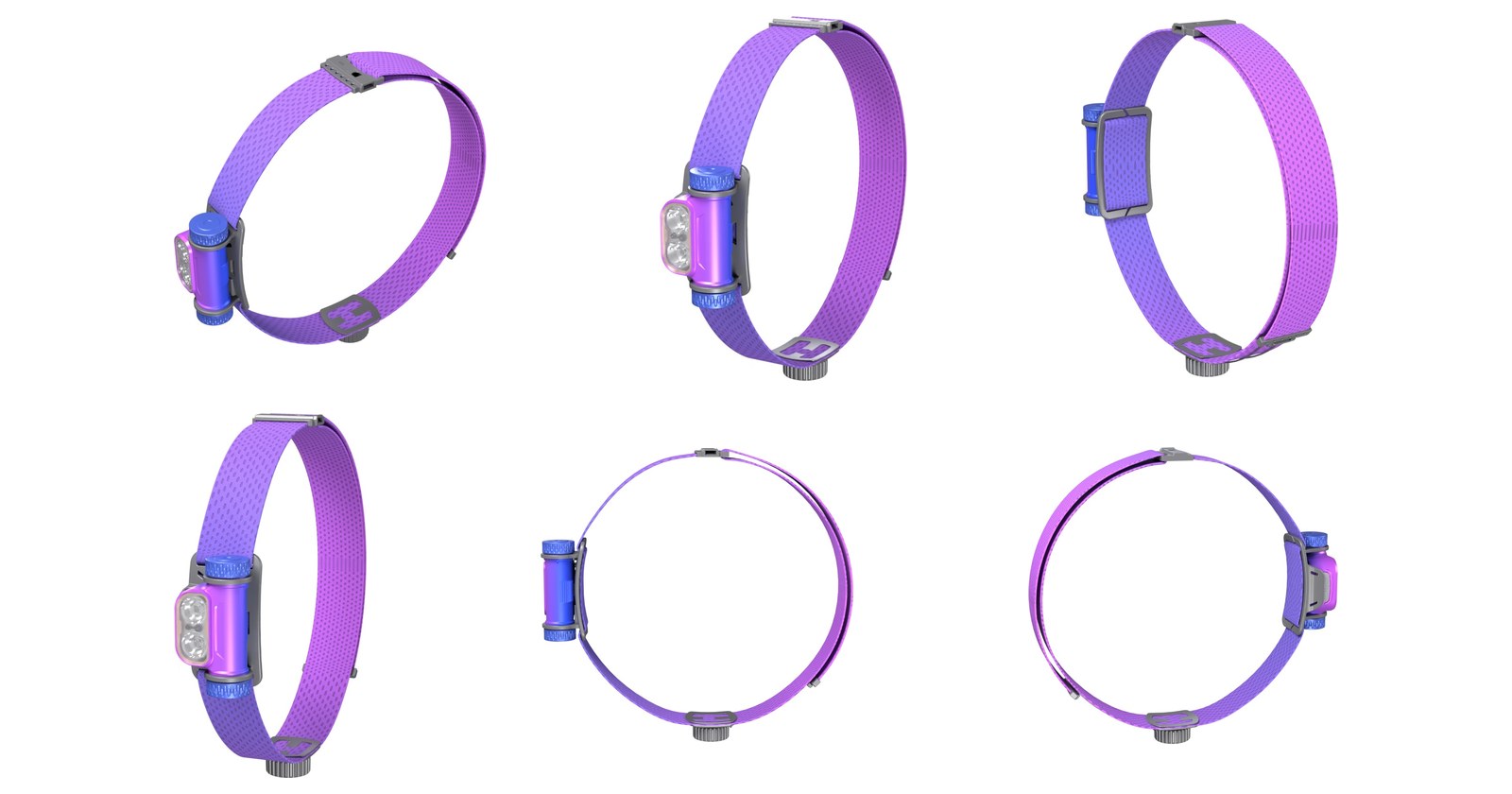
The grams that decide whether it bounces
A headlamp on a running head is a mass on the end of a spring. Every extra gram forward of the band increases the oscillation with each foot strike, and oscillation is what a reviewer notices in the first ten minutes — more than lumens, more than finish.
Cell in the body, nothing behind the head
Both platforms carry the cell in the lamp. That removes the rear pack, the cable, the strain-relief entry and the counterweight needed to balance a pack — on a split design that is often 80 g or more sitting at the back of the skull, moving out of phase with the front. The mass that remains is forward, low and close to the band, so it tracks the head instead of lagging it.
The band is where cheap programmes give back the weight they just saved. A wide elastic band with a silicone grip line weighs more than a narrow one and holds a 135 g body far more steadily at pace. We spend grams there on purpose, and we would rather quote the honest total than a lamp-only figure that a reviewer re-weighs on camera.
What the figure includes
Lamp, cell and headband, as shipped, on a calibrated balance. No packaging, no spare cell, no cable. Published as a ceiling rather than a typical value — 105 g and 135 g are numbers a unit will not exceed, so the figure on your retail box stays true across batches.
A mass claim without an output figure next to it is a marketing number. 135 g at 1,600–1,800 lm in a sealed metal body is a comparison; 135 g on its own could be a 200 lm lamp with a heavy band.
18350, 18650, or a pack on the back
Three architectures, three different products. The choice is a market decision before it is an engineering one.
| Architecture | Mass, all in | Where it wins | Where it loses |
|---|---|---|---|
| 18350 in the lamp HL-M2 |
105 g | Lightest complete lamp. Cell charges through USB-C on the cell itself, so a spare can be swapped in the field without a charger or a tool. | Roughly a third of the energy of an 18650. Sustained output has to be chosen around that, not around a peak figure. |
| 18650 in the body HL-M1 |
≤135 g | Double the energy or more, 1,600–1,800 lm available, still nothing behind the head. Accepts a CR123A backup in the same tube. | 30 g heavier and a larger casting, so it sits in a specialist tier rather than the volume one. |
| 2×21700 rear pack HL-M3 — not for running |
413 g with pack | 4,000 lm and 450 m for professional and helmet use. | A cable and a pack on the band, at three and a half times the mass. Wrong tool for a running line, and we say so. |
Per-mode runtime is published with the ANSI/NEMA FL1 report at launch, not before — we would rather give you the mode table for the exact configuration you order than a headline figure that changes with the LED bin. If you need a runtime figure to build a claim on, ask and we will measure the configuration you specify.
Cold is the qualifier nobody puts on the box. Cell capacity falls steeply near freezing, and a night section at 2 °C is where a runtime claim made in a 25 °C lab stops being true. If your market runs in winter, say so at sample stage and we will set the low-temperature cut-off and the mode table around it.
What these two platforms do, and what they do not
It saves us both a sample cycle if we are explicit about the gaps.
On the mould
- Sealed metal body, IP68 to 2 m, 2 m drop tested on the current configuration.
- Spot + flood + red guide light, independently controlled.
- Cell in the lamp, USB-C charging: on the cell itself (M2) or under a sealed flap (M1).
- CR123A backup in the M1 tube — useful for a crew-supported ultra where a spare is easier to find than a charger.
- Adjustable band with a rear bracket that carries the adjuster, so the cast body is not also a hinge.
Not on the mould
- No rear red marker. The red source is a front guide light. A rear marker is a band accessory and a separate part to tool, certify and stock.
- No 21700 in-lamp option. The compact castings are sized for 18350 and 18650.
- No external pack for running. The split-pack platform is a helmet lamp at 413 g.
- No custom optic. The reflector and TIR are fixed on the mould; the LED bin, the drive current and the mode order are what you can change.
- No zoom bezel. We do not build sliding optics — they wear and they leak.
Six decisions before a quote means anything
Output tier
The sustained figure, and the burst you will allow on a descent. This drives the cell and the thermal design, so decide it first.
Beam and control
Which source is on in which mode, and whether the wearer can run both. Mode order is the part reviewers complain about.
Cell and charging
18350 or 18650, USB-C on the cell or on the body, and whether a spare cell is part of the retail package.
Mass ceiling
The number you will print. Set it as a maximum, then hold the process to it — a typical value will be beaten by the next batch.
Band and mount
Band width, grip line, and whether the line needs a rear marker or a helmet clip. These are the parts that decide comfort, and they are usually specified last.
Market and paperwork
CE/UKCA, UN38.3 for the cell in transit, the retail box claims, and the language on the insert. Bring the market and we will list what is needed.
Trail running headlamp questions
How many lumens do you need for a trail running headlamp?
300–500 lm on non-technical trail at pace; 500–800 lm for a technical descent, where you are reading the ground 15–20 m ahead. Under 300 lm is fine on fire roads. The sustained mode matters more than the peak.
Is 1,000 lumens too much for running?
Not too much — usually aimed wrong. In a tight spot it creates a bright tunnel and kills your peripheral vision. With a spot plus a wide flood and separate control, high output is useful for descents and marker spotting.
Do trail runners need a rear red light?
On roads and at mass-start night events, often yes, and some races require one. It is a band accessory rather than a housing feature, and it is not on the two platforms here — their red source is a front guide light.
18350 or 18650?
18350 for the mass-led tier at about 105 g; 18650 for runtime and output at about 135 g. Runners going long usually carry a spare cell, so a cell you can swap without tools matters more than a bigger built-in one.
How long does the battery last?
Per-mode runtime is issued with the FL1 report for the exact configuration you order, not as a headline figure. Ask for the mode table at the output you plan to sell and we will measure it.
Are they waterproof?
IP68 to 2 m on both platforms, with a 2 m drop test on the current configuration. Rain and sweat are the real exposure; the rating is what a retail buyer compares.
Can I brand it as my own?
Yes — that is the only way we sell. Housing, optic and sealing are fixed on the mould; LED bin, colour temperature, driver levels, cell, finish, logo and packaging are yours. No tooling invoice on a standard model.
Do you sell to individual runners?
No. Brands, importers and retailers only. If you are choosing a lamp for yourself, use the numbers above on any product page — that is the same brief we give our customers.
Building a trail line? Tell us the output tier and the mass you can sell.
We will tell you which platform fits, what it weighs with the cell and band, and where the gaps are before you commit to a sample.